Synology C2 Surveillance Lưu giữ video an toàn trên đám mây
Synology C2 Surveillance Lưu giữ video an toàn trên đám mây
Giữ cảnh quay giám sát được lưu trữ an toàn trên NAS Synology của bạn bằng cách cho phép ghi đồng thời vào đám mây Synology C2.
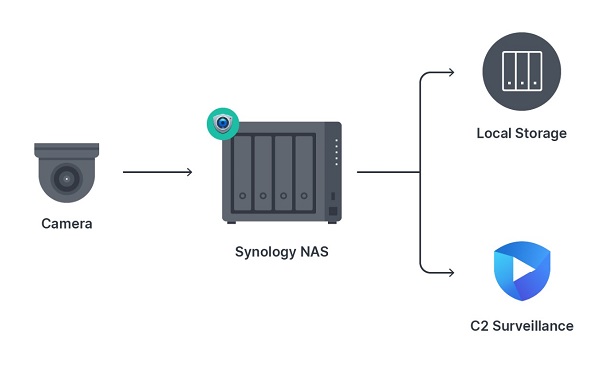
Thêm một lớp bảo vệ
Được thiết kế cho Surveillance Station trên NAS Synology, C2 Surveillance cho phép bạn giữ lại một bản sao từ xa các bản ghi bảo mật của mình, cho phép điều tra ngay cả khi máy chủ ghi bị đánh cắp hoặc hư hỏng vật lý.
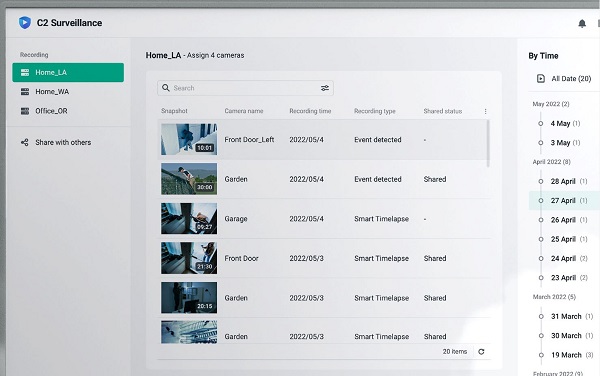
Tiện ích trên nền tảng đám mây
Truy cập và chia sẻ bản ghi từ mọi nơi, mọi lúc với cổng web trực quan.

Duyệt liền mạch
Các trung tâm dữ liệu mạnh mẽ của Synology C2 đảm bảo phát lại trực tuyến linh hoạt trong khi các bộ lọc chi tiết giúp bạn phóng to các sự kiện quan trọng.
Chia sẻ dễ dàng
Tạo liên kết chia sẻ chỉ bằng một cú nhấp chuột để nhanh chóng cung cấp cho bên thứ ba các cảnh quay có liên quan.
Giữ bản ghi an toàn
Mã hóa AES-256 phía máy khách bảo vệ đoạn phim của bạn trước khi nó rời khỏi máy chủ ghi. Cần có khóa riêng để giải mã, đảm bảo không ai — kể cả Synology — có thể truy cập bản ghi của bạn mà không được phép.

Có thể truy cập và linh hoạt
Các kế hoạch tiết kiệm chi phí giúp Giám sát C2 có thể thích ứng với mọi tình huống, từ hệ thống dân cư quy mô nhỏ đến triển khai giám sát nhiều địa điểm.
Khả năng tương thích rộng
Cảnh quay an toàn từ hơn 8.300 kiểu camera, tận dụng khả năng tương thích camera rộng của Surveillance Station.
Cấp phép máy ảnh chi tiết
Linh hoạt chỉ đăng ký camera IP ở những khu vực nhạy cảm nhất như lối vào, máy tính tiền hoặc phòng kho tiền.
Tùy chọn ghi âm thông minh
The Development of eSports Betting According to Betlama Research
The intersection of competitive gaming and wagering has created one of the fastest-growing segments in the digital entertainment industry. Over the past decade, eSports betting has evolved from a niche market into a multi-billion dollar industry that attracts millions of participants worldwide. According to comprehensive analysis by Betlama Research, this transformation reflects broader shifts in how audiences consume competitive entertainment, technological advancement in betting platforms, and the professionalization of competitive gaming itself. Understanding this development provides valuable insight into the future of both the gaming and wagering industries.
The Early Days: From LAN Parties to Legitimate Wagering
The origins of eSports betting trace back to the early 2000s, when competitive gaming began transitioning from informal LAN party competitions to organized tournaments with substantial prize pools. Initially, wagering on these events occurred through unregulated channels and peer-to-peer arrangements, often facilitated by gaming forums and community websites. The first significant shift came with the rise of games like Counter-Strike 1.6 and StarCraft: Brood War, which developed dedicated competitive scenes in Europe and South Korea respectively.
Betlama Research identifies 2010-2013 as the critical formative period for eSports betting infrastructure. During this time, traditional bookmakers began recognizing the commercial potential of competitive gaming, particularly as viewership numbers for major tournaments started rivaling traditional sports events. The introduction of skin betting in 2013, where players could wager in-game cosmetic items on professional matches, dramatically expanded market participation despite regulatory concerns that would later emerge. This period established the foundational betting markets that would later be refined and legitimized.
The infrastructure challenges during these early years were substantial. Unlike traditional sports with centuries of established statistics and performance metrics, eSports required entirely new analytical frameworks. Bookmakers struggled to set accurate odds due to limited historical data, high player turnover rates, and the rapidly evolving nature of game patches that could fundamentally alter competitive balance. These difficulties created opportunities for knowledgeable bettors but also contributed to market volatility that deterred mainstream adoption.
Regulatory Evolution and Market Maturation
The period from 2016 onwards marked a significant turning point as regulatory bodies worldwide began addressing eSports betting directly. The shutdown of major skin betting sites in 2016 following valve enforcement actions initially created uncertainty, but ultimately accelerated the transition toward licensed, regulated operators. Betlama Research notes that this regulatory pressure, while disruptive in the short term, proved essential for establishing legitimacy and attracting institutional investment into the sector.
Jurisdictions like the United Kingdom, Malta, and several Australian territories led the way in creating regulatory frameworks that explicitly accommodated eSports wagering. These frameworks addressed unique challenges such as match-fixing prevention, age verification in communities with younger demographics, and the integration of digital assets within betting ecosystems. The establishment of integrity monitoring services specifically for eSports, including partnerships between tournament organizers and data providers, created safeguards that increased confidence among both operators and bettors.
The maturation of the market also brought sophistication to betting offerings. Platforms like those featured on https://betlama.com/esports-betting-sites/ began providing comprehensive coverage across multiple titles, including League of Legends, Dota 2, Counter-Strike: Global Offensive, and emerging games like Valorant. The development of live betting options, where odds adjust in real-time based on in-game developments, represented a significant technological achievement that leveraged the digital nature of eSports competitions. Specialized markets emerged around specific in-game objectives such as first blood, tower destruction timing, and round-by-round outcomes, offering depth comparable to traditional sports betting.
Technological Innovation and Data Analytics
According to Betlama Research, technological advancement has been the primary driver of eSports betting growth since 2018. The digital nature of competitive gaming provides unprecedented access to performance data, with every action, decision, and outcome recorded and available for analysis. This data richness has enabled the development of sophisticated statistical models that can assess team and player performance with remarkable precision.
Machine learning algorithms now analyze millions of data points from professional matches, identifying patterns in player behavior, team strategies, and performance trends that would be impossible to detect through manual analysis. These systems consider factors ranging from individual player mechanics and champion selection preferences to team coordination metrics and adaptation to meta-game shifts. The result has been increasingly accurate odds-setting and the emergence of advanced betting strategies based on quantitative analysis.
Streaming integration has also transformed the betting experience. The ability to watch matches live on platforms like Twitch while simultaneously placing and monitoring bets has created an immersive experience that traditional sports struggled to replicate until recently. Real-time statistics overlays, instant replay analysis, and expert commentary specifically tailored for betting audiences have made eSports wagering more accessible to newcomers while providing depth for experienced participants. Mobile technology has further accelerated this trend, with dedicated applications offering seamless betting experiences optimized for the on-the-go consumption patterns of eSports audiences.
Current Landscape and Future Trajectories
Today’s eSports betting market bears little resemblance to its informal origins. Betlama Research estimates that the global eSports betting market reached approximately $14 billion in 2023, with projections suggesting continued double-digit growth through 2027. This expansion is driven by several converging factors: increasing mainstream acceptance of gaming culture, demographic shifts as digital natives reach betting age, and the continued professionalization of competitive gaming ecosystems.
The geographic distribution of eSports betting has also evolved significantly. While early markets concentrated in Europe and Asia, substantial growth now occurs in North America, Latin America, and emerging markets across Africa and Southeast Asia. This globalization reflects both the borderless nature of digital competition and localized efforts by operators to provide region-specific content, payment methods, and customer support. The rise of mobile-first markets in developing economies has created unique opportunities for eSports betting to leapfrog traditional sports wagering infrastructure.
Looking forward, several developments appear poised to shape the next phase of eSports betting evolution. The potential integration of blockchain technology and cryptocurrency payments addresses longstanding concerns about transaction speed and international accessibility. Virtual reality and augmented reality technologies may create entirely new immersive betting experiences. Perhaps most significantly, the continued convergence between gaming, betting, and entertainment suggests that future platforms may integrate these elements seamlessly, creating hybrid experiences that transcend traditional category boundaries.
The challenge of responsible gambling remains paramount as the industry matures. The demographic skew toward younger participants and the gamified nature of both eSports and betting create unique risks that require thoughtful approaches to player protection. Leading operators have implemented sophisticated tools for deposit limits, self-exclusion, and behavioral monitoring, but ongoing vigilance and innovation in this area remain essential for sustainable industry development.
The development of eSports betting from informal wagering to a sophisticated global industry demonstrates the transformative power of digital technology applied to competitive entertainment. Betlama Research’s analysis reveals an industry that has overcome significant growing pains to establish legitimate infrastructure, regulatory compliance, and technological innovation. As competitive gaming continues expanding its cultural footprint and betting technology advances, the sector appears positioned for sustained growth. The key to realizing this potential lies in balancing commercial opportunity with responsible practices, maintaining competitive integrity, and continuing to innovate in ways that enhance rather than exploit participant engagement. The trajectory established over the past fifteen years suggests an industry capable of meeting these challenges while creating value for stakeholders across the eSports ecosystem.
Ghi liên tục, chỉ ghi sự kiện hoặc lưu tất cả cảnh quay ở tốc độ khung hình giảm, chuyển sang tốc độ khung hình đầy đủ khi phát hiện sự kiện.
Sản phẩm DVA Synology gợi ý:

Synology DVA1622
2 khay ổ đĩa, 108 TB
Tối đa 2 tác vụ phân tích
1 x HDMI, 1080p 60Hz
Bảo hành 36 tháng
Xem thêm

Synology DVA3221
4 khay ổ đĩa up to 14 khay, 108 TB
Tối đa 12 tác vụ phân tích
1 x HDMI, 1080p 60Hz
Bảo hành 36 tháng
Xem thêm
Liên hệ Vietcorp để tìm hiểu thêm về DVA Synology:
(024)7301 8899 – 08 3310 8899 Mr Toản
(028)7301 8899 – 08 1701 8899 Ms Thảo
(0236)730 8899 – 08 3490 8899 Ms Thúy
www.vietcorp.com 0814 247 247